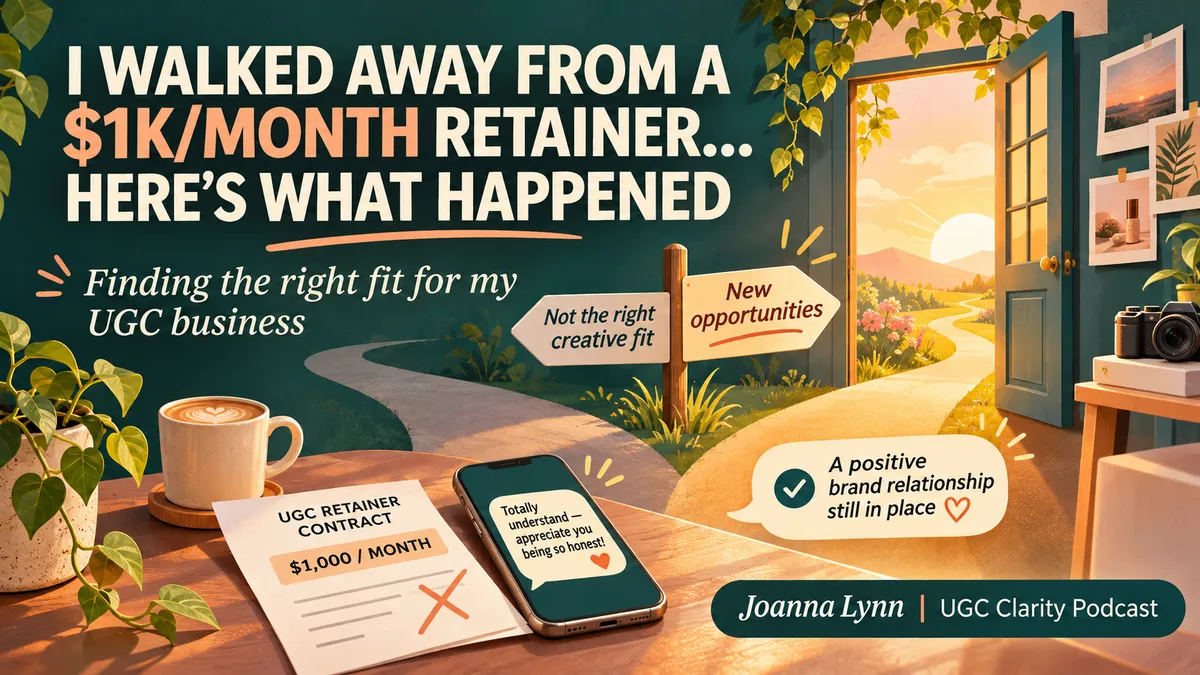
I Walked Away From a $1K/Month Retainer... Here’s What Happened What turning down an opportunity taught me about finding the right fit for my UGC business
“Not every opportunity that we can take is an opportunity that we should take.”
Joanna Lynn
I recently walked away from a UGC opportunity that could have paid me $1,000 a month.
And let me tell you, sending that message did not feel good.
I had already been accepted. I had already started creating the content. This was the first time I’d begun working on an opportunity and then had to turn around and say, “I don’t think I can do this.”
The brand wasn’t doing anything wrong.
The money wasn’t the problem.
The opportunity just wasn’t the right fit for the way I create.
But when you’re looking at the possibility of consistent monthly income, admitting that to yourself can be hard.
And when you start doing the math?
That’s potentially $12,000 a year.
So yes, after I sent that message, I laid there wondering if I’d just made a huge mistake.
Why I Applied for the Retainer
One of the things a lot of creators want is consistency.
You don’t necessarily want to start every month wondering where your next brand deal is coming from. So when you see an opportunity for ongoing work with the potential to pay $1,000 a month, of course it gets your attention.
It definitely got mine.
I applied, and I was accepted almost immediately.
Then I got into the campaign and saw exactly what they wanted the creators to make.
The brand provided very specific examples and wanted us to recreate them pretty closely. When I say closely, I mean they wanted the videos to be about a 90% match to the examples.
And I tried. I really did.
The Content Was Getting Views, But It Wasn’t Converting
The videos I created for the campaign weren’t necessarily doing badly when it came to views. People were watching them.
But they weren’t turning into sales.
And for this campaign, sales were the goal.
What made it even more frustrating was that I had already created content for this same brand before joining the campaign. Those earlier videos had generated more than $3,000 in revenue for the brand.
So I knew I could create content that worked for their product.
The difference was that my earlier videos came naturally to me. I wasn’t trying to match someone else’s delivery, pacing, and style as closely as this campaign required.
There’s a difference between looking at a video for inspiration and trying to recreate it almost exactly.
Sometimes you can see why a concept works, take that idea, and make it your own.
But when I tried to match the examples as closely as the brand needed, it just wasn’t working for me.
Sending the Message Was Hard
Eventually, I had to make a decision.
Did I keep going because I didn’t want to walk away from the potential income?
Or did I tell the brand the truth?
I decided to be honest.
I explained that I didn’t think I was the right fit for what they needed from creators in that particular campaign.
Then I sent the message and hung my head.
Because immediately, the questions started.
“Did I just make a huge mistake?”
“Should I have tried harder?”
“Could I have figured it out?”
And I had no idea how the brand was going to respond.
Would they be irritated?
Would they think I was unprofessional?
Had I just burned a bridge with a brand I had already created successful content for?
I went to sleep that night not knowing.
Their Response Surprised Me
The next morning, I woke up to their reply.
They actually applauded me for being professional about it.
They acknowledged that I already had multiple videos performing for them. They knew my content worked. They just needed a very specific kind of content for this particular campaign.
And here’s the part I wasn’t expecting.
They told me they were still watching the content I was creating and might come back to ask about licensing some of my existing videos.
They also said they would reach out if another campaign came along that was a better fit for my style.
So no, I hadn’t burned the bridge.
The possibility of licensing content or working together again wasn’t a guarantee, but the conversation was still open.
And honestly, that meant a lot.
Being Honest About the Fit Was Better for Both of Us
I could have stayed because I didn’t want to lose the potential money.
I could have kept forcing myself to create content in a style that wasn’t working for me.
And I probably would have become more and more frustrated.
At the same time, the brand might have become frustrated because they weren’t getting the specific content they needed.
Instead, I was honest about what I could confidently deliver.
The brand respected that.
Now, I can’t promise every brand will respond the same way. But being clear and professional gave us the chance to have a good conversation and leave the relationship open.
Knowing Your Strengths Takes Time
When you’re brand new to UGC, it’s normal to want to try everything.
A brand wants to pay you to make a video?
“Yes! I’ll figure it out!”
And honestly, trying different kinds of content can be a great way to learn what you enjoy and what you’re good at.
But the longer you create, the more you start noticing patterns.
There may be certain briefs you read and immediately see the video in your head.
Certain products you can talk about naturally.
Certain types of content you genuinely enjoy making.
Then there are other projects where every part feels like you’re pulling teeth.
That doesn’t necessarily mean you’re incapable of doing the work. It might mean it isn’t where you’ll do your best work, or it isn’t the kind of work you want to build your business around.
Knowing your limits doesn’t make you a bad creator.
It can help you become more confident about the opportunities you choose.
My Portfolio Needed to Reflect the Work I Want
This experience also got me thinking about my portfolio.
I’ve created content for physical products for years, and I still enjoy doing that. I’m not saying I’ll never make another physical product video.
But I’ve realized how much I enjoy creating content for apps, technology, games, AI tools, and software.
Give me something on my phone or computer that I can demonstrate, screen record, and explain, and I’m excited to create.
So I started thinking: If that’s the kind of work I want more of, how are brands supposed to know that if my portfolio doesn’t show it?
I’ve been planning to overhaul my portfolio so it includes more examples of the exact kind of content I want brands to hire me to create.
Because your portfolio can do more than show everything you’ve ever made.
It can also show people where you want your business to go.
Where I’ve Seen Ongoing UGC Opportunities
One question I hear a lot is, “Where are creators finding retainer work?”
In the podcast episode, I mentioned two platforms I had been looking at: Side Shift and Euka.
Both are places where creators may find brand campaigns and ongoing opportunities. Euka is also connected to TikTok Shop campaigns, and it’s where I was approved for the retainer I talked about in this post.
That doesn’t mean every opportunity on either platform will be the right fit for you. Campaigns, requirements, and compensation can vary.
And downloading an app doesn’t guarantee you’ll land a retainer tomorrow.
You still need to look at the work, understand what the brand expects, and decide whether the opportunity makes sense for your business.
But if you’ve been relying on the same one or two places to find work, they may be worth looking into.
An Acceptance Doesn’t Mean You Have to Say Yes
I also shared in the episode that I’d been accepted by two brands on Trybe and decided not to move forward with one of them after reading the agreement.
I wasn’t comfortable with some of the terms.
And that’s something I want creators to remember: being accepted for an opportunity doesn’t mean you have to agree to it.
Take time to read the details. Ask questions. Make sure you understand the compensation, usage rights, and expectations before you move forward.
It’s okay to be excited about an opportunity and still decide it isn’t right for you.
The Right Fit Matters
Walking away from the potential $1,000 a month wasn’t easy.
But it helped me get clearer about the kind of work I enjoy and the kind of content I can confidently create for brands.
The brand needed a specific style for that campaign. I knew my strengths were better suited to something else.
We were able to be honest about that and keep the conversation open.
So if you’re considering an opportunity right now, look beyond the number for a moment.
Ask yourself:
“Do I understand what the brand needs?”
“Can I deliver it confidently?”
“Does this fit the kind of work I want to do?”
You’re allowed to ask those questions, even when the opportunity looks great on paper.
🎧 Want to hear the full story? Listen to “I Walked Away From a $1K/Month Retainer... Here’s What Happened” on the UGC Clarity Podcast. Listen here.
💜 Looking for a place to ask questions, share your wins, and learn alongside other creators? Join the free UGC Clarity community here.
Share This Blog
Know a creator who’s trying to decide whether an opportunity is the right fit? Share this post with them!